Fun & Viral
The Emu War Was Three Soldiers and a Newspaper Nickname

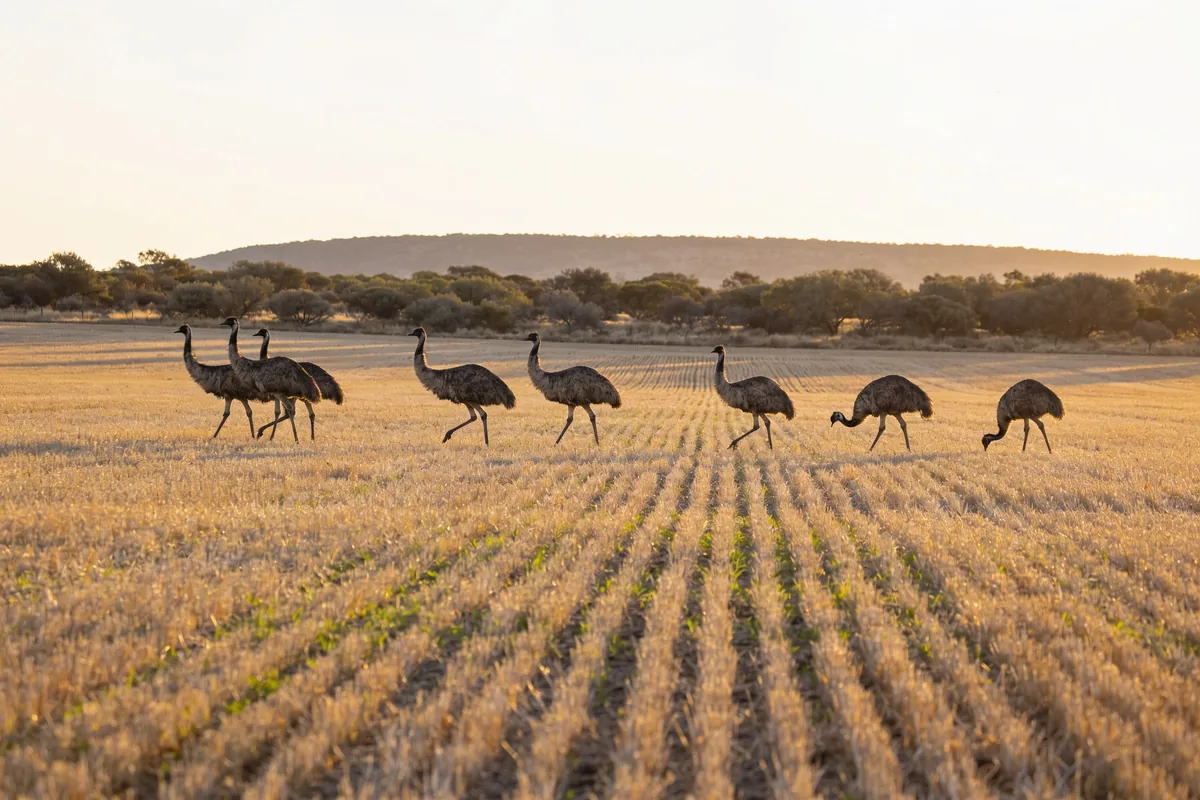
Picture a paddock at dusk on the edge of the wheat belt. The crop stands tall and pale, almost silver in the last of the light, and a wire fence along one side sags between its posts where something has leaned on it. Out in the wheat, a loose mob of tall birds walks through without hurry. Each step lays a few stalks flat. Behind the mob the crop looks combed the wrong way, a trail of pressed-down gold you could follow across the whole paddock.
Nobody is in the picture. The paddock belongs to no one in particular, and the scene is a sketch to hold in the mind rather than a real farm. But the shape of the problem is easy to read. A season of work is standing in the field, a fence meant to keep smaller pests out has become a gap, and the visitors are a good deal bigger than rabbits and not remotely interested in being moved on.
Walk toward them and the mob drifts off, then drifts back when you stop. Shout and they scatter into a dozen small groups, each as hard to approach as the last. A rifle can reach one bird, perhaps two, but the rest are already gone, and by morning the mob is whole again, eating its way down the next row.
So what would anyone in 1932 have done about it? Asked the government, as it turns out.
Why soldiers were asked
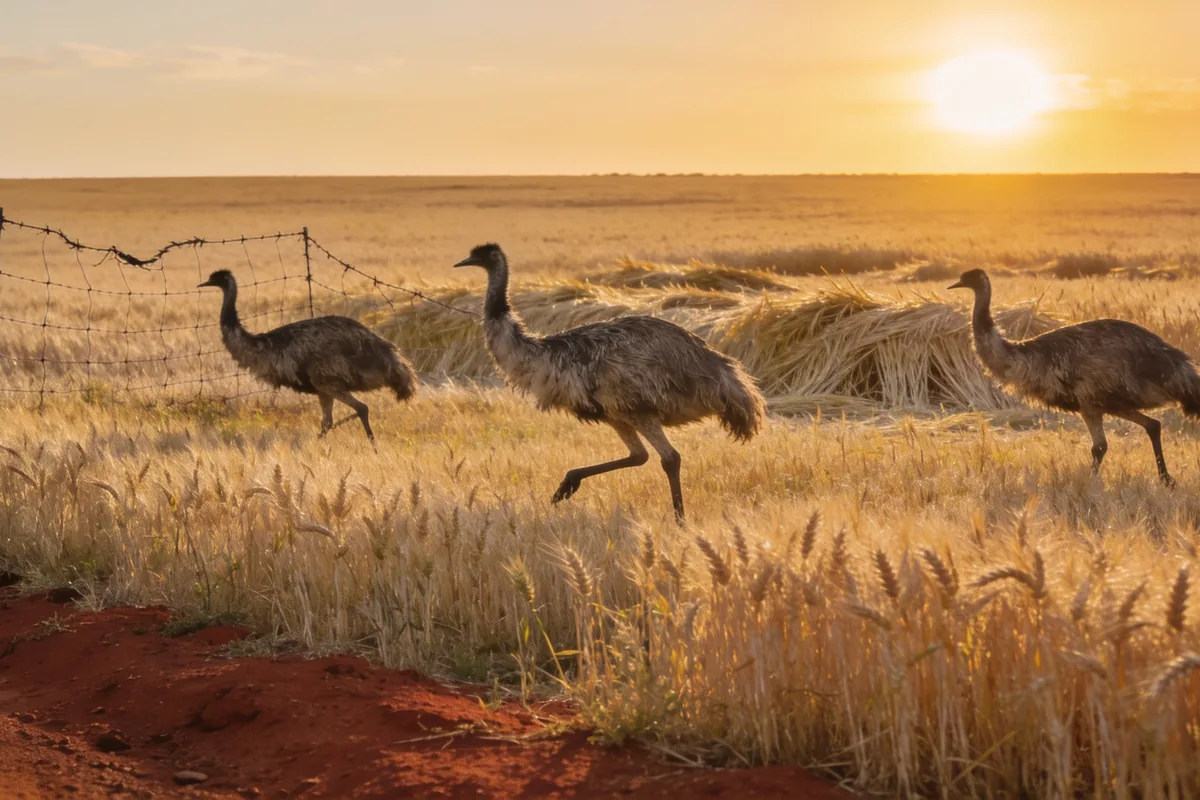
The record is specific about who asked. Commonwealth Hansard for the House of Representatives, 9 November 1932, reports a deputation of soldier settlers from the fringe of the wheat belt who put their case to the Defence Minister. After a dry spell inland, they said, thousands of emus had come onto the wheat country, where they were damaging rabbit-proof fences and flattening crops. Ordinary firearms were no use, because the birds dispersed, so the settlers suggested the military’s Lewis guns.
Pearce gave the Government’s side in the Senate on 18 November. The guns could not simply be handed to people outside Commonwealth control, so he agreed to send three members of the permanent military personnel with them. The State Government undertook to pay the railway fares and to pay for the ammunition used. There was no extra pay for the men and no cost to the Commonwealth. The House had already been told the same on 9 November: the bill was to be shared between the State and the settlers.
The Evening News in Rockhampton filled in the preparations on 17 October 1932. The party was to leave Perth, carrying 10,000 rounds, with the Lewis gun chosen over a Vickers because it was easier to handle. The State’s Premier was quoted as saying the State would meet the cost of sending the men. None of this reads like a declaration of war. It reads like a request to the Defence Department, granted on the condition that someone else cover the costs.
Three soldiers, two guns, one dam
The party was small. Major Meredith led it, with Sergeant S. McMurray and Gunner J. O’Halloran, according to the Evening News on 17 October; the Perth Daily News of 3 November shows the two gunners firing the first shot. Australian Geographic says they unpacked two Lewis guns and 10,000 rounds at Campion, where the Evening News’s preview had spoken of a Lewis gun and 10,000 rounds. The Daily News reported the first shots at Campion on the afternoon before its 3 November issue, which puts them on 2 November.
Then comes the dam. The Kalgoorlie Miner of 5 November, in a report dated Campion, 4 November, described an ambush built around a red danger flag raised to draw the birds in. A mob of over 100 was held back about 300 yards off in a hollow, until it came within about 100 yards and the gun opened up. The mob scattered. The same report put the birds’ pace at about 30 miles an hour.
The Telegraph in Brisbane, reporting from Perth on 5 November in its 7 November issue, gave a second scene. A flock it estimated at 1,000 came no nearer than 1,200 yards, and the gunner fired at that range. Meredith was reported as saying of the birds’ toughness: “It is more than astonishing. It is miraculous. If I had a division of men who could carry bullets like that I would take on any army in the world.” That is the Telegraph’s version of what he said, delivered as spoken that day, and it stands as a newspaper’s report rather than a signed statement.
Put the three pieces together and you get a small party, two guns, a lot of rounds and birds the gunners could not clear.
Who called it a war
The Daily News of 3 November put the word war in quotation marks in a photo caption, which reads like a newspaper holding a joke at arm’s length. Its column of 9 November, headed “The Emu War”, runs the joke at length in military language. And on 10 November the West Australian’s headline announced that the emu war was over.
Parliament used other words. The House item was titled “Destruction of Emus”, and the speakers talk of an expedition and of destroying the birds. On 8 November, Thorby asked who was responsible for “this farce” and who was “footing the bill”. His question also placed the hunt in Central Australia, with machine guns on lorries, a mistake taken from a press report. In the Senate on 18 November, Pearce again said destruction. One senator did use the phrase emu war that day, but inside quotation marks, as something quoted rather than adopted.
The ruling is a short one. War was a nickname the newspapers made, and Parliament mostly declined to use it. That doesn’t make the nickname wrong to enjoy. It only means the word belongs to the headlines rather than to the Commonwealth’s own record.
Why the guns were pulled, and why they came back
The order to withdraw went out from Canberra on 8 November, according to the Sydney Morning Herald of 9 November. It reached the commandant in Perth on 9 November, according to the West Australian of 10 November. Two reasons are on the official record, and neither is money.
Pearce told the Senate that he had acted on press paragraphs saying the shooting had been ineffective. The West Australian reported a staff officer’s statement that headquarters did not want a precedent set for destroying noxious birds and animals in this way, and that the State Agriculture Department had not been consulted.
One satirical Daily News column of 9 November repeated Canberra gossip about political and financial implications, but it gave no detail or source, so it is not an official reason.
Money comes up because it is the popular explanation: the army stopped to save money. The record points the other way. On 8 November Lyons told the House that the Defence Department was not paying the cost of the expedition, and on 9 November the House was told that the cost was to be borne by the State and the settlers jointly. Pearce’s Senate account says the same of the fares and ammunition. On the official record, saving the Commonwealth’s money doesn’t fit as the reason.
The settlers saw it differently. A message to a State parliamentary staffer, reported on 10 November, said it was imperative that the gunners stay, because emus were reappearing in numbers. Pearce told the Senate that after protests from the wheat areas and from the Premier, he was informed that hundreds of birds had been shot and that the birds had returned in thousands once the shooting stopped. He agreed the guns should go back. The operation was reinstated on 12 November and ended for good on 10 December, according to the ABC.
One more detail is worth keeping apart. The Herald’s report of the House exchange on 8 November carries jokes about a medal for those taking part in the war and about the emus having won every round so far. The Hansard text for 8 and 9 November has only Thorby’s question and Lyons’s reply. The best-known lines are the newspaper’s, not the parliamentary record’s.
The tallies, side by side
The table gives each figure with the document that supplies it.
| Question | What each source says | Who says it | Note for the reader |
|---|---|---|---|
| How many emus were in the district? | Thousands (the settlers’ deputation as relayed by the Government); as many as 20,000; at least 20,000 | Hansard (House, 9 Nov 1932); ABC (10 Dec 2022); Australian Geographic (18 Oct 2016) | Estimates, not a count |
| First operation (2 to 8 Nov): how many emus killed? | Hundreds of birds (as Pearce was informed); between 300 and 500; somewhere between 50 and 200 | Pearce, Senate, 18 Nov 1932; ABC; Australian Geographic | Three sources, three ranges |
| First operation: rounds fired | About 2,500 | ABC; Australian Geographic | The two later accounts agree on rounds |
| Second operation (from the reinstatement to 10 Dec): emus killed | Thousands of fatalities, as claimed by Meredith | ABC (10 Dec 2022) | A claim; the report itself is not among the sources cited here. A very precise figure repeated online traces to none of them and is not printed |
| Soldier casualties | None | Australian Geographic (Meredith noted no casualties) | |
| Who paid? | The State and the settlers jointly; no cost to the Commonwealth | Hansard (House, 9 Nov; Senate, 18 Nov) | Answers the stopped-to-save-money reply |
This post does not print a single kill total for the whole affair, because the sources do not agree and the second operation’s own report is not among them.
Look at the first operation’s row and the disagreement is plain. Pearce, working from what he had been told, said hundreds. The ABC gives 300 to 500. Australian Geographic gives 50 to 200. Those ranges overlap only at the edges, and the three accounts were written at three different distances from the events. Where they do agree, on about 2,500 rounds for the first operation, the figure is the steadiest one on the page.
The district count is the softest number of all. It begins as the settlers’ thousands, is relayed through the Government, and ends up as 20,000 in two later accounts. It was an estimate in 1932 and it is an estimate now. The sources cited here don’t say how anyone counted a mob that kept moving.
What thinned the emus after the guns
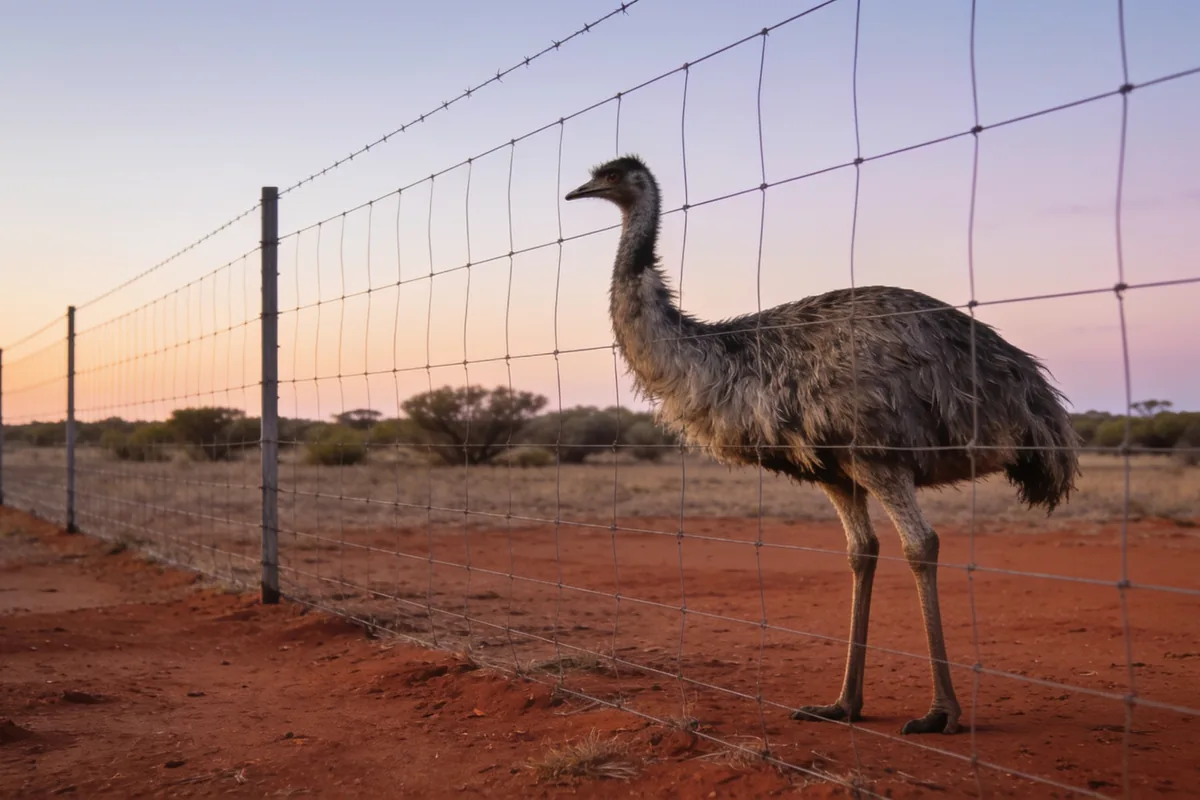
The record after the guns is quieter. Australian Geographic, on 18 October 2016, says a bounty proved the most effective measure, with about 284,700 emus killed in Western Australia between 1945 and 1960, and adds that emu numbers remain stable. The ABC’s feature of 10 December 2022 says emus remained a problem in later decades despite an expanded barrier fence and a State bounty.
Read together, the two accounts do not credit the guns or the fence alone. Australian Geographic gives the bounty as the most effective measure, while the ABC says emus stayed a problem in later decades despite both the expanded fence and a bounty, so the two do not fully agree. That makes the emus-won line a quip and the fence-won line an incomplete story. This post takes no side on wildlife management. It only notes what the sources say changed the numbers. For a very different Australian wildlife question, the site has a separate piece on what to do when you find a flying fox on the ground.
What the Record Leaves Unsettled
The record leaves a good deal open: how many emus were in the district, how many were shot in each operation, and what the second operation really achieved. It settles the rest. Settlers asked, three soldiers went, the State paid, the newspapers called it a war, and the guns were pulled and sent back. The joke survives because its first two parts are true. The gunners could not clear the birds, and the guns were stood down more than once.
When a history story is too funny to be true, ask who asked for it, who paid and who counted.
Sources: Commonwealth Parliamentary Debates, Senate, 18 November 1932 (https://historichansard.net/senate/1932/19321118_senate_13_137/); Commonwealth Parliamentary Debates, House of Representatives, 8 and 9 November 1932 (https://historichansard.net/hofreps/1932/19321108_reps_13_136/ and https://historichansard.net/hofreps/1932/19321109_reps_13_136/); The West Australian, Emu war ends, 10 November 1932, via Trove, National Library of Australia (https://trove.nla.gov.au/newspaper/article/32593678); The Sydney Morning Herald, War on emus, 9 November 1932, via Trove (https://trove.nla.gov.au/newspaper/article/16929343); The Evening News (Rockhampton), 17 October 1932, via Trove (https://trove.nla.gov.au/newspaper/article/198815580); The Daily News (Perth), 3 November 1932 and 9 November 1932, via Trove (https://trove.nla.gov.au/newspaper/article/82880105 and https://trove.nla.gov.au/newspaper/article/82880770); The Kalgoorlie Miner, 5 November 1932, via Trove (https://trove.nla.gov.au/newspaper/article/94775028); The Telegraph (Brisbane), 7 November 1932, via Trove (https://trove.nla.gov.au/newspaper/article/179536818); ABC News, Australia’s Emu War spawns feature film, jokes and memes 90 years on, 10 December 2022 (https://www.abc.net.au/news/2022-12-10/great-emu-war-90-years-on-army-wheatbelt-battle-history/101752238); Australian Geographic, Looking back: Australia’s Emu Wars, 18 October 2016 (https://www.australiangeographic.com.au/nature-wildlife/2016/10/australias-emu-wars/)


