Automotive
Some Car Noises Can Wait, but a Grind Shouldn’t

Don’t drive on a new noise and hope it goes away. It won’t, and the hope costs more than the noise does.
That doesn’t mean every rattle is a disaster. Some car noises can wait for the next service, some need a look this week and a few mean you pull over now. The skill is telling them apart, and you can get most of the way there without a tool in your hand.
The test: ask four questions
Before you decide how worried to be, answer these. They also happen to be the questions a workshop will ask.
- When does it happen? Only on a cold start? Only when you brake? Only when you turn the wheel? At a steady speed?
- Where does it come from? The front, the rear, under the floor, the engine bay, one wheel.
- What does it sound like? A squeal, a click, a knock, a grind, a hum, a rattle. Say it out loud if that helps.
- Does it change? With speed, with load, with the weather, with how long the car has been running.
The same noise means different things depending on the answers, so the answers matter more than the label.
What the common noises usually point to
This table is a guide, not a diagnosis. A noise that matches a row is a reason to get the car checked, not proof of the cause.
| Noise | When | Usually points to | How soon |
|---|---|---|---|
| High squeal | When braking | Brake pads worn down to their wear indicator | Soon. This week, not next month |
| Grinding | When braking | Pads worn through, metal on metal, which can damage the discs | Now. Stop driving it and have it checked |
| Clicking or ticking | When turning, especially on full lock | A worn constant velocity (CV) joint, often after a torn rubber boot | This week |
| Knocking or pinging | From the engine, especially under load | Several possible causes, including low oil, poor combustion or internal wear | Check the oil level when it’s safe. If it persists, get it checked promptly |
| Grinding | When changing gears | Clutch wear, low transmission fluid or damaged gears | Soon. These repairs get dearer the longer they’re left |
| Hum or whine, rising with speed | At a steady speed or accelerating | A wheel bearing, tyre wear or something in the drivetrain | This week |
| Rattle | Over bumps or at certain revs | Often a loose heat shield or exhaust mount, but also suspension parts | Usually can wait a short while, but have it looked at |
| Squeal | On start-up or when turning the wheel | A belt or pulley, or low power steering fluid | Soon |
Two rules sit above the table. If the noise comes with a warning light, a burning smell, a change in how the brakes feel, steering that pulls or any loss of power, stop in a safe place. And if you hear grinding when you brake, treat the brakes as the problem until someone has proved otherwise.
Why the grind is the one that matters
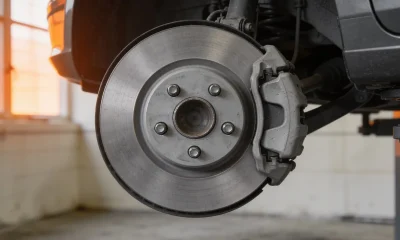
A brake squeal is a polite request. Many pads have a small metal tab that touches the disc when the pad wears low and makes a squealing sound, designed to tell you it’s time. A grind is what happens when you’ve ignored the request. The pad material is gone, the metal backing plate is against the disc and every stop is wearing something that was never meant to wear. That’s the point where a pad replacement can turn into a pad and disc replacement, and where stopping distances can lengthen.
Knocking from the engine is the other noise that doesn’t improve with time. If the oil warning light is on, stop the engine as soon as it’s safe. Driving on with no oil pressure is how a repair becomes a replacement.
Noises that are less alarming than they sound
Not every noise is serious, and it’s worth saying so. A loose heat shield can rattle like a failing exhaust. A stone caught in a tyre tread can click for a kilometre or two. Brakes can squeal after the car’s been sitting in damp weather and stop within a few stops. Many cars make light clicking sounds as the engine and exhaust cool after a drive.
The fair counterpoint to “never ignore a noise” is that not every sound means a big bill, and a car that’s cried wolf once doesn’t need a panic response. But the cheap way to find out which kind you have is to listen carefully and get it looked at, not to wait.
What to tell the workshop
A mechanic can find a fault faster if you give them the same information you gathered above. Write it down or put it on your phone before you go in.
- When it happens: cold, warm, braking, turning, accelerating, at a certain speed.
- Where it seems to come from.
- What it sounds like, and whether it changes.
- How long it’s been going on, and whether it’s getting worse.
- Any warning lights, smells or vibrations that came with it.
- Any recent work on the car, including new tyres or brake jobs.
Record a short clip of the noise if you can do it safely, with a passenger holding the phone, not while driving. And ask for the finding in writing: what’s wrong, what needs doing now, what can wait, and what it’s likely to cost. A good workshop will separate the urgent items from the optional ones.
If you’re worried about being sold work you don’t need, our post on whether your mechanic is helping you save money or spend more covers the questions to ask. For a hum or a vibration, it’s worth knowing the difference between a bearing problem and a tyre one, and our explainer on wheel balancing covers the second, along with the matter of tyre repairs.
What to do before the noise starts
Most noises get cheaper if you catch them early, and most are early warnings. Look at the service schedule in your owner’s manual, check fluid levels now and then, and replace brake pads when they’re worn, not when they’ve failed.
Write it down, then book it in
When you next hear something new, pick the answers to the four questions, write them down and book it in. A noise you can describe is half a diagnosis.
Sources: Your vehicle’s owner’s manual (the service schedule, warning lights and brake sections for your model)