DIY & Crafts
Treat Old Paint as Lead Paint Until a Lab Says Otherwise

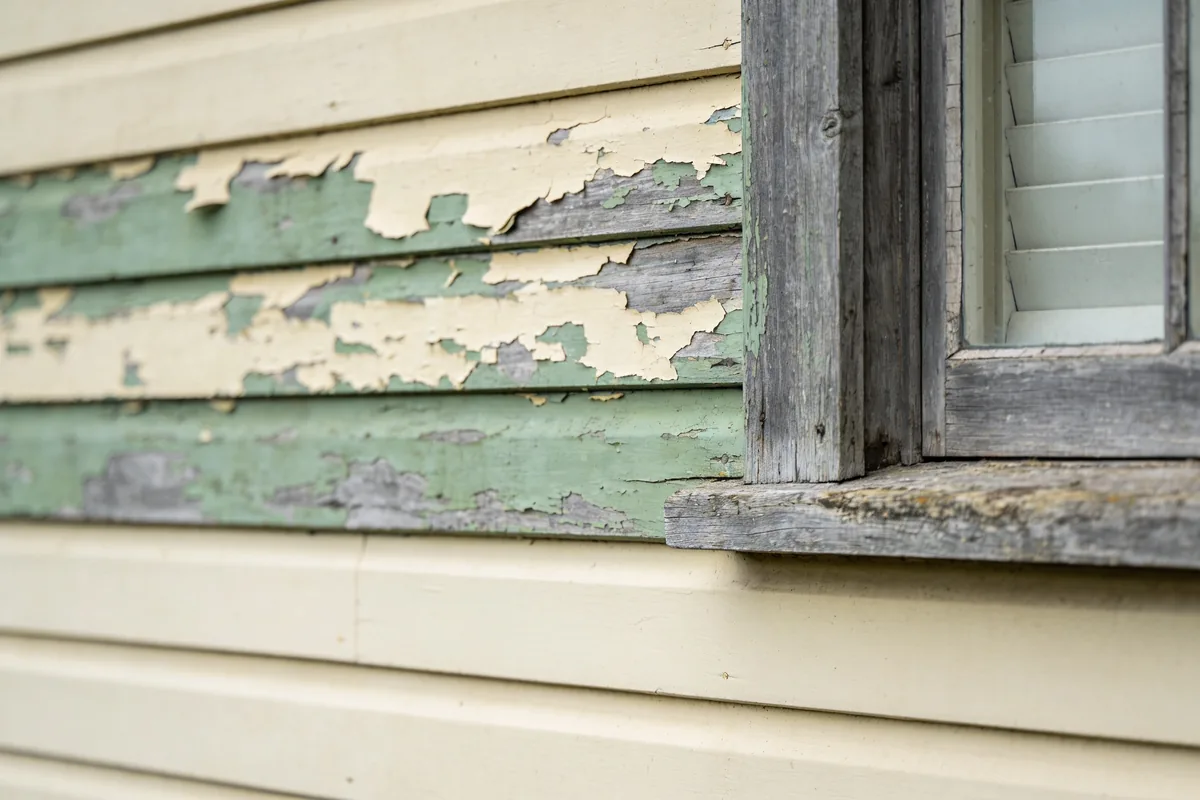
Job for today: find out what is under the paint before anything touches it. About 45 minutes. Old paint can be lead paint, and these six steps come before any tool does.
- Write down the year the house was built, and any repainting you know about. Five minutes.
- Walk the house with masking tape and mark every painted surface you plan to sand, scrape, strip or drill. Ten minutes.
- Note which of those surfaces are peeling, flaking or chalking and which are sound. Ten minutes.
- Put each marked job against the table in “What to do for each job” below. Ten minutes.
- Decide who will be out of the house on work days: children under five, anyone pregnant or breastfeeding, pets. Five minutes.
- Park every dry sanding, dry scraping and heat-gun job until a test result is back. Five minutes.
Treat paint in a house built before the mid-1970s as lead paint until a laboratory says it is not. This post is general information about lead only, drawn from guides as published at 12 July 2026. The Australian Government’s Lead Alert guide (5th edition, 2016) and your state or territory health department are the authority, and other hazards in old houses have their own rules.
Why the dust, not the paint, is the problem
Paint that is sound and left alone isn’t the problem. Queensland’s Metro North Public Health Unit (October 2023) says lead paint does not pose a risk while it is intact, but that it “poses a health risk when it starts to deteriorate due to ageing, or if it is disturbed during renovations”. Its examples are burning, sanding, scraping and demolition. The danger is the dust and chips you make, not the wall you leave alone.
That matters because the amounts involved are small. Lead Alert says “Even small amounts of dust or chips of paint containing lead can be a health risk”. It adds that children can absorb “up to 60 per cent” of the lead they swallow, while adults absorb “approximately one tenth”. A single flake the size of a five cent piece, it says, “can increase blood-lead levels for several weeks”.
Nothing here calls for panic. The job is keeping the dust from forming, and most of this post is method for that. If you’re concerned about past exposure, a doctor is the right person to ask about a blood test, and both Lead Alert and the NSW EPA point readers that way. Pregnant or breastfeeding women and young children should leave the house whenever lead paint is being disturbed, according to Lead Alert, and WA Health puts it bluntly: “Do not renovate when children are present.”
How old is old? Where the pages differ
The official pages don’t agree on a cut-off. Lead Alert, the NSW EPA and Metro North all say before 1970. SA Health says to assume lead in every house built before the mid-1970s. The table lines them up.
| Source | Cut-off | What it adds |
|---|---|---|
| Lead Alert (2016) | “Homes built before 1970 are most at risk” | Homes built after 1970 “might still contain paint with more than 1 per cent lead” |
| NSW EPA (September 2024) | “lead-based paint on houses built before 1970” | Points readers to hardware-store test kits as the first step |
| Metro North (October 2023) | Houses “built prior to 1970 pose the greatest risk” | Intact paint is not a risk; disturbed paint is |
| SA Health (file dated February 2023) | “assume all houses built prior to the mid-1970s” | Homes built up to the 1940s are “especially hazardous”; later homes “can still be a risk if old house paint or industrial or marine paint has been used” |
Use the later cut-off for a DIY decision. If you’re choosing whether to test, caution costs you one test, and Lead Alert itself says that homes built after 1970 can still contain paint with more than 1 per cent lead. Age is a reason to test, never a clearance.
There was no single ban date, which is why “when was lead paint banned” has no tidy answer. SA Health describes a phase-down: the 1969 uniform paint standard was amended from 50 per cent to 1 per cent, then 0.25 per cent in 1992, 0.1 per cent in 1997 and 0.009 per cent in 2021. Lead Alert adds that paint with as much as 50 per cent lead went on the inside and outside of homes built before 1950.
A swab is a screen, not a clearance
The NSW EPA tells readers to test painted surfaces with kits from major hardware retailers, and WA Health points the same way. Lead Alert prints a warning beside that advice: colour-change kits “can give false negative and false positive results”, and the colour change is hard to see on dark paint. If the swab doesn’t change colour, it says, that “may not mean that there is no lead in that sample”. SA Health calls kits “relatively cheap and quick to use but … limited in their accuracy”.
So here is the ruling this post uses:
- A positive swab is enough to act on. Treat the paint as lead paint.
- A negative swab on a house built before the mid-1970s is not a clearance. Send a sample.
- A laboratory test settles it. Use a NATA-accredited laboratory.
One approach is to assume it’s lead and plan for the worst case. The official pages agree. SA Health says that if you suspect lead but haven’t tested, “assume it does and take precautions”, and that it isn’t possible to know whether paint has lead in it by its appearance alone.
If you do sample, the guide’s advice is to take all the layers, or at the least the oldest ones. Chips taken at an angle show the layers, and the underside of a flake is worth testing. Lead Alert also says that only laboratory analysis can determine whether working on the paint is ‘lead risk work’, which contractors must notify in advance. That last part is a contractor rule, and it doesn’t change anything for a home job.
What to do for each job
Go back to your marked surfaces from step 4 and find each job in the table. Jobs fall into three groups: leave it, change the plan, or don’t do it at all.
| Planned job | What the official pages say | Source |
|---|---|---|
| Leave it alone | Intact lead paint is low risk; inspect it regularly | Metro North; Lead Alert |
| Paint over | Fine if the paint is in good condition and not flaking or chalking; a temporary measure | Lead Alert; WA Health |
| Flaking or chalking | Consider full removal or replacing the part; light wet sanding only, to key a repaint | Lead Alert |
| Strip or scrape | Wet scraping, wet sanding or chemical stripping; a trained contractor comes first in Lead Alert’s order of preference | Lead Alert; NSW EPA |
| Replace (skirting boards, architraves, sashes) | No cleaning and no lead waste from stripping, though the removed parts still need disposing of | Lead Alert |
| Dry sanding or abrasive blasting | Do not | Lead Alert |
| Open flame or high-temperature heat gun | Do not; lead fumes form above 370 degrees C | Lead Alert; NSW EPA |
| Dry power sanding with a HEPA attachment | “not recommended for the home handy person”; contractors only | Lead Alert |
The table leaves out costs, local council or state rules, and clearance levels, because the pages above don’t give a single answer to any of them.
Can you just paint over lead paint?
Often, yes, with conditions. Lead Alert says that if the paint “is in good condition and it is not flaking or chalking, you can cover it by painting over it”. WA Health says to consider painting over if the renovation can’t be done without generating a lot of dust and fumes.
The conditions are short:
- Wash the surface with a trisodium phosphate (TSP) solution first. Check your sugar soap, because “Not all brands of sugar soap contain TSP”.
- Sand only if the paint is flaking, only lightly and only wet, so the new paint will stick.
- Seal interior walls, then topcoat.
- Still remove the paint from parts that get knocked or rubbed: architraves, skirting boards, balustrades, stair treads and sash windows.
Lead Alert also reminds readers that painting over is “a temporary solution limited by the life of the paint and the condition of the surface”.
The paint-over camp has a fair point. Most DIY painting over sound paint is low risk, and this post isn’t telling anyone to stop. The danger is in disturbing paint, and a washed, sealed and topcoated surface disturbs very little.
Set up so the dust has nowhere to go
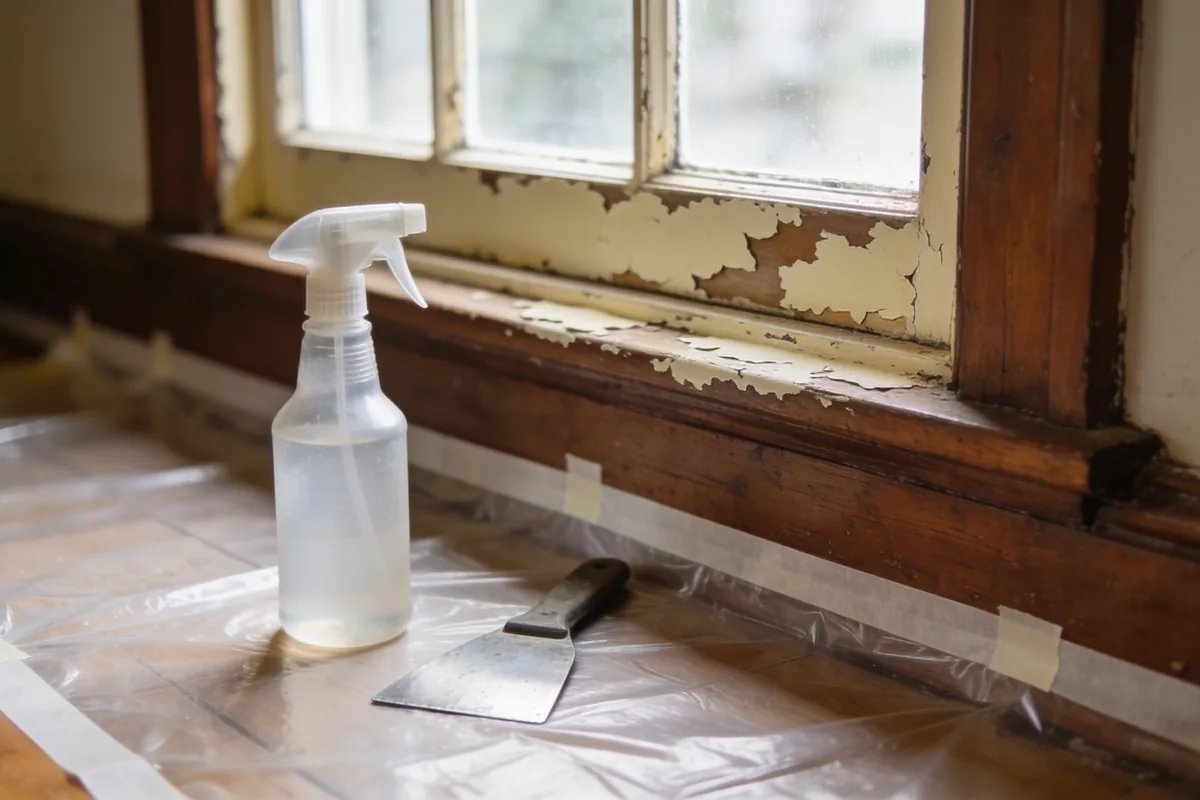
Lay disposable plastic sheeting and tape it down. Cloth drop sheets hold dust that you then carry through the house. Outside, run the plastic out “two metres from the base of the home”, plus a metre for each storey. Close windows and vents. Skip windy and wet days, tell the neighbours and cover sandpits, pools and vegetable patches.
For your own protection you need a respirator to AS 1716 with P1 or P2 filters. Lead Alert says “Ordinary dust masks are not effective”, and the NSW EPA says “Basic paper masks may not fit well and do not protect against fine dust.” Add disposable coveralls, don’t eat or drink in the work area, and shower afterwards.
For the paint itself, use wet scraping and wet sanding: spray the surface, then scrape onto the sheet. Chemical strippers are another route, but only with the label’s directions and a vapour cartridge, and never in a sealed room. On heat, the pages differ again. Lead Alert says nozzle temperatures should stay below 370 degrees C because lead fumes form at higher temperatures. The NSW EPA says not to use open-flame torches or heat guns at all. For a home job, keep wet methods first and the heat gun last, if you use one.
The dust extractor is where people get caught. Lead Alert says not to remove paint by dry abrasive blasting or dry mechanical sanding, yet it also lists dry power sanding with a HEPA vacuum attachment. That method “is not recommended for the home handy person” and “can be done safely only by contractors”, and “ordinary vacuum cleaners are dangerous because they allow lead dust out through their exhausts”. For a home job, then, no dry sanding of any kind. A workshop vacuum on a sander is not a HEPA system.
Clean up wet, then dispose with care
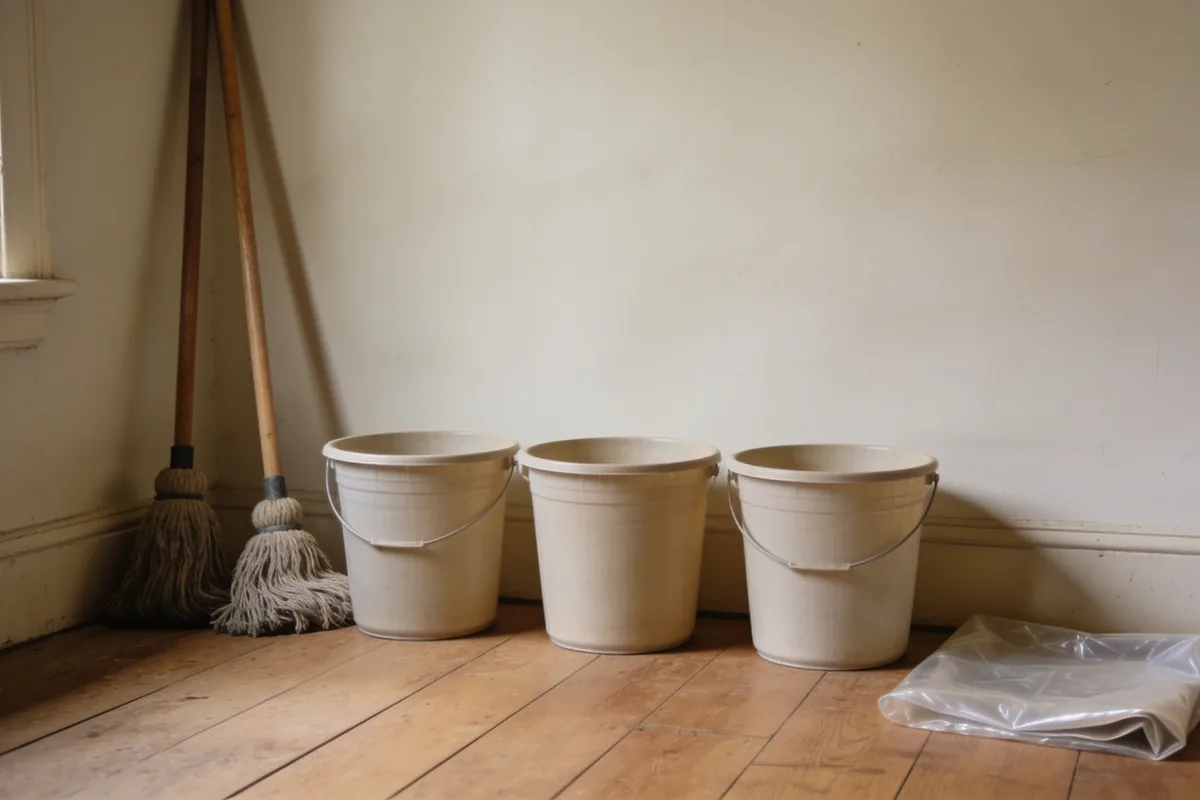
Wet the dust down before you lift any sheet. Don’t reach for the broom. Lead Alert says “Do not use a broom as this spreads the dust. Do not use a vacuum cleaner without a HEPA filter as it will spread the fine dust containing lead around the home.” Use a HEPA vacuum, then wash surfaces with a phosphate detergent and rinse. The guide describes a three-bucket method for the wash and rinse.
If you already wipe with a damp cloth, you know the idea. Why a damp cloth beats a dry duster covers the same rule at household scale.
Water and waste need thought too. Lead Alert says “Do not pour lead contaminated water down your drains or onto your garden.” It says lead paint waste “can be classified as hazardous waste”, so contact your local council for guidance before you dispose of anything. And don’t burn lead-painted timber.
When the job is for a trained contractor
Large areas, flaking paint, a heritage house, or a young child or a pregnancy in the home all point towards a professional. The NSW EPA’s advice is to “hire a professional who is trained and qualified to work safely with lead” if lead is present, and Lead Alert puts a trained contractor first in its order of preference, saying that “ideally, homes with paint containing lead should be assessed and remediated by trained professionals”.
When you choose one, ask for evidence of lead-paint training. The general method of checking every line of a quote works for any trade job, this one included.
Before the First Scrape
Next job: book the laboratory sample, or write “lead” across your plan in marker until the result is back.
Sources: Lead Alert: The six step guide to painting your home, 5th edition, Commonwealth of Australia, 2016 (https://www.agriculture.gov.au/sites/default/files/documents/lead-paint-fifth-edition.pdf); Lead: gardening and home renovations, NSW Environment Protection Authority, September 2024 (https://www.epa.nsw.gov.au/sites/default/files/24p4541-lead-gardening-and-home-renovations.pdf); Fact Sheet: Lead-based paint, SA Health (https://www.sahealth.sa.gov.au/wps/wcm/connect/d43c4d8048f12740888aef0e3d7ae4ad/Fact+Sheet+-+Lead-based+paint.pdf); Lead exposure risk reduction: advice for patients, Western Australia Department of Health, 2021 (https://www.health.wa.gov.au/~/media/Corp/Documents/Health-for/Environmental-health/Chemical-Hazards/fact-sheet-lead-exposure_riskreduction.pdf); Common causes of non-occupational lead exposure, Metro North Public Health Unit, Queensland Health, October 2023 (https://metronorth.health.qld.gov.au/wp-content/uploads/2023/11/non-occupational-lead-exposure.pdf)