
Healthcare
Weighing All-on-4 Against Dentures: Questions for Your Dentist

Deciding what to do about a full set of failing or missing teeth is a lot to carry around, and it’s completely ordinary to feel overwhelmed by it. There are brochures that promise a new smile, relatives who swear by their dentures, and a quote with a number on it that you haven’t quite looked at yet. You might find it helps to put the sales language aside for a moment and start with one question: what is each option like to live with day to day?
This guide walks through All-on-4 implants and conventional dentures side by side. It can’t tell you which is right for your mouth, because that depends on your bone, your gums, your general health and your budget. What it can do is give you the words and the questions to bring to a proper conversation with your dentist.
What All-on-4 means
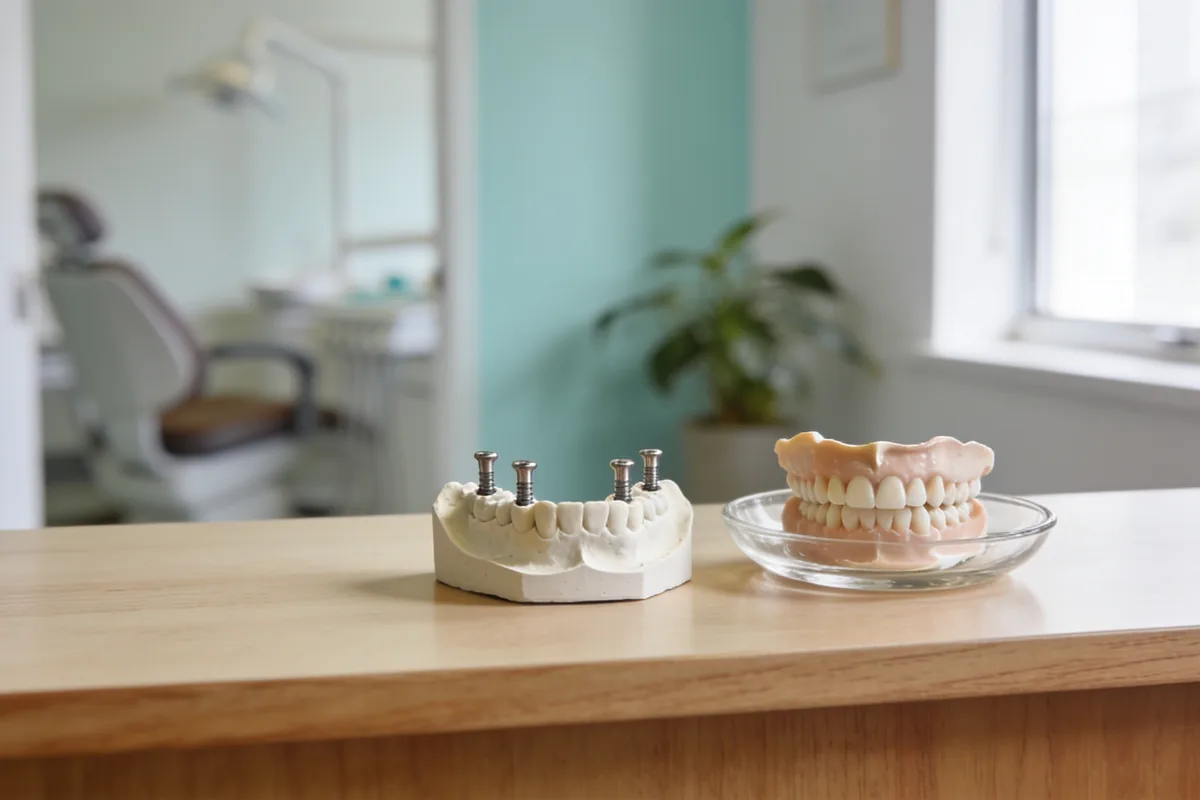
All-on-4 is a way of replacing a full arch of teeth, the whole upper or the whole lower set, using four dental implants. An implant is a small post, usually titanium, placed in the jawbone to act like a tooth root. In this approach, a dentist places four implants in one jaw and attaches a fixed set of replacement teeth to them. The back two implants are often angled, which in some cases allows them to be anchored in available bone without extra bone grafting.
“Fixed” is the key word. Unlike a denture, the new teeth are screwed to the implants and are not meant to be taken out by you at home. A dentist or prosthodontist can remove them for servicing.
Some practices offer a temporary fixed set shortly after surgery, with the final set made once the gums and bone have healed. Whether that suits you depends on the strength of your bone and how the implants settle, so it’s a question for your own assessment, not something to assume.
How dentures work
A conventional full denture is a removable plate with teeth on it. An upper denture is held in place mainly by suction against the roof of the mouth. A lower denture has less to grip, because the tongue is in the way and there’s no roof for suction, so lower dentures are the ones people most often find loose.
Dentures can also be held more firmly by a small number of implants. These “implant-retained dentures” sit between the two options: they still come out for cleaning, but they clip onto implants and move less. It’s worth asking about them if the full All-on-4 approach feels like too big a step.
Comfort and function compared
Comfort is the heart of most people’s decision, so it’s worth being fair to both sides.
A fixed implant set doesn’t slip, doesn’t need adhesive and generally feels more like your own teeth, because it is held by the bone rather than resting on the gums. Many people find chewing firmer foods easier with it.
Dentures have real advantages too. They’re a less invasive route, because they don’t need surgery in the jaw. They can be adjusted or remade, and they usually cost less up front. Bone naturally shrinks after teeth are lost, which is why a denture that fitted well can loosen over time and need relining. That’s a common experience, and it isn’t a sign you’ve done anything wrong.
What the bright brochures tend to skip is the maintenance on the implant side. A fixed set isn’t the same as natural teeth. Food and plaque can collect around and under the bridge, so you’ll usually be shown how to use small interdental brushes or a water flosser, and you’ll need regular reviews. Implants can also fail, most often when infection sets in around them. Gum disease, smoking and poorly controlled diabetes are all known to raise the risk. Your dentist should talk through these things before you agree to anything.
What the procedure involves
The details differ between practices, but the path usually looks something like this:
- An assessment, including a conversation about your health history and medicines, an examination and scans of your jawbone.
- A treatment plan and a written quote, which you can take away and think about.
- Surgery to place the implants, done under local anaesthetic, sedation or general anaesthetic depending on the plan.
- A healing period, with a temporary or interim set of teeth if the plan includes one.
- Fitting of the final fixed set, then regular reviews and cleaning.
None of this needs to be settled in a single appointment. It’s okay to take the quote home, and it’s okay to ask for a second opinion. A good practice won’t hurry you.
Questions worth asking before you decide
You might find it easier to write these on a card and bring it with you.
- Is my bone suitable for All-on-4, or do I need grafting or a different approach?
- Is this the best option for my mouth, and what are the alternatives, including implant-retained dentures?
- Who will place the implants, and who will make and fit the teeth? You can check that any dental practitioner is registered through the national register run by Ahpra, and that anyone calling themselves a specialist holds that endorsement.
- What is included in the quote: scans, surgery, temporary teeth, the final teeth, follow-up visits and anaesthesia? What is not included?
- What happens if an implant fails or the teeth break, and what does the practice cover?
- How will I clean the teeth, and how often will I need reviews?
- How long is the healing period, and what will I eat during it?
Written answers are worth having. If a practice is happy to put things in writing, that’s a good sign.
Paying for it
Dental implants are generally expensive, and costs vary widely between practices and cases. This article doesn’t quote a price, because a figure here could be out of date within a year and wouldn’t reflect your own treatment. The best number is the one on your own written quote.
Medicare generally doesn’t cover routine dental care, and private health extras policies usually pay only up to annual limits for major dental work, so the rebate may be small or nothing. Before you commit, ask your fund what it would pay for the specific item codes on your quote, in writing. The same approach applies to any big out-of-pocket health cost: our guide to reading your policy for laser eye surgery shows the kind of questions worth putting to a fund, and they carry across. If your goal is mainly a change in how your teeth look, you may also like our piece on cosmetic dentistry.
A calm way to start
If all of this still feels like a lot, take it as one small page. Write down what bothers you most about your current teeth, whether that’s loose dentures, difficulty chewing or how you feel about your smile. Add your medicines and any health conditions. Then book an assessment, ask your questions, and take the quote home.
You don’t have to decide in the chair. Both All-on-4 and dentures are sound options for the right person, and the point of the conversation is to find out which one is right for you.
Sources: Healthdirect Australia, dental implants information (https://www.healthdirect.gov.au/procedures/dental-procedures-and-appliances/dental-implant); Australian Dental Association, consumer information on dental implants and dentures (https://www.ada.org.au); Ahpra, national register of practitioners (https://www.ahpra.gov.au/Registration/Registers-of-Practitioners.aspx); Healthdirect Australia, Cost of dental care (https://www.healthdirect.gov.au/healthcare-and-services/costs-and-financial-support/cost-of-dental-care)


You must be logged in to post a comment Login